If you have ever driven through Corinth and wondered why some streets feel instantly memorable, the answer is not just the houses themselves. It is the way the city grew, block by block, from its railroad-era roots into a layered residential pattern that still shapes daily life today. If you are trying to understand what gives Corinth’s older neighborhoods their appeal, this guide will help you make sense of the architecture, lot layouts, streetscapes, and historic-district rules that matter most. Let’s dive in.
Why Corinth’s older neighborhoods feel distinct
Corinth was established in 1855 at the railroad crossover of the Memphis & Charleston and Mobile & Ohio lines. That early rail connection helped shape the downtown grid, nearby residential blocks, and the city’s long-standing identity.
Today, preservation sources say Corinth contains two historic districts. The city’s land development code also treats the oldest residential areas as a defining part of Corinth’s character, not simply as older housing stock.
In practical terms, that means many of Corinth’s most recognizable neighborhoods were planned as part of a broader historic fabric. They connect to downtown, reflect early subdivision patterns, and still carry a strong sense of place.
How street patterns shape neighborhood character
One reason older Corinth neighborhoods feel different from newer subdivisions is the street layout. The city’s planning code describes the traditional historic neighborhoods as the core of Corinth, organized around a dense street grid with historic residential areas, old-growth tree canopy, pedestrian facilities, and small parks.
That pattern creates a more connected feel. Instead of long curving streets and deep setbacks, you often see shorter blocks, homes oriented toward the street, and a closer relationship between houses, sidewalks, and public space.
Historic records for downtown show that many original blocks measured about 200 feet square, with some railroad-fronting blocks 150 feet deep. The same records note that lots in the business district were commonly 25 feet wide, and several full-sized blocks north of the railroad retained internal alleys.
What architectural styles you may see
Corinth is not defined by a single home style. The Midtown Corinth Historic District documentation identifies 12 historic architectural styles and 15 traditional house types, which gives buyers a wide range of home designs to explore.
Some of the styles documented in Corinth include:
- Greek Revival
- Italianate
- Gothic Revival
- Queen Anne
- Colonial Revival
- Neoclassical Revival
- Craftsman
- Second Empire
- Art Moderne
- French Eclectic
- Minimalist Traditional
- Tudor Revival
That mix helps explain why one block may include very different-looking homes that still feel cohesive together. You may see older cottages, Victorian-era houses, early-1900s homes with formal detailing, and later infill in the same general historic area.
Historic homes that show Corinth’s range
A few documented homes help illustrate Corinth’s architectural variety. The Fish Pond House at 708 Kilpatrick Street is recorded by the Mississippi Department of Archives and History as a vernacular Greek Revival cottage built in 1857.
The Veranda House at 711 Jackson Street is described in its National Register nomination as a significant Greek Revival home adapted to a domestic scale. Its narrow veranda and double-pile plan show how formal design ideas were interpreted for residential use.
For a later Victorian look, the Samuel D. Bramlett House at 1125 Cruise Street is recorded as a Queen Anne house dating to 1893. It is also identified as one of several notable Late Victorian houses in Corinth.
The B.F. Liddon House at 804 Webster Street reflects yet another layer of style. It is classified with Colonial Revival, Neoclassical, and Gothic Revival influences, and is described by MDAH as a largely Neoclassical two-story stone home with a Corinthian tetrastyle portico and a round corner tower.
Common house types in Corinth
Style is only part of the story. Corinth’s historic district records also identify a broad set of traditional house forms that buyers may encounter.
These include:
- Center-hall plans
- Double-cribs
- Saddlebags
- Modified shotguns
- Double-shotguns
- Composite cottages
- Cubical or pyramidal cottages
- Bungalows
- Four-squares
- Saltboxes
- Capes
- English cottages
- Homestead houses
- Side-hall townhouses
- Side L-plan cottages
If you are home shopping in Corinth, this means you may notice a lot of visual variety even within a compact area. Different rooflines, porch shapes, and floor plans are part of what gives these neighborhoods their lived-in, layered character.
How lots and setbacks affect the feel
Older Corinth neighborhoods can feel more urban than some buyers expect in a small Mississippi city. That comes partly from lot size, block structure, and how homes sit on their sites.
In Traditional Neighborhood Development Historic and Infill areas, the city says lots generally start at 8,000 square feet. The code also notes that blocks are small and arranged on a grid, with residential facades typically having shallow setbacks.
The Downtown Residential Overlay adds another detail that matters. Front yard setbacks should be the lesser of 25 feet or the average setback of other houses on the block, and new construction or additions should be placed in harmony with nearby homes in terms of spacing, orientation, and setback.
That helps preserve a consistent streetscape. When homes line up in a similar way and face the street with porches, entries, and windows, the block often feels more settled and visually connected.
Why walkability still matters in Corinth
Corinth’s older neighborhoods were not built around modern subdivision patterns. They were built around a more traditional layout that supports walking, block-to-block connectivity, and a stronger relationship between homes and the street.
The city code reinforces that character. In historic and infill areas, access often comes from local streets, alleys, or shared access points, and parking is expected behind or beside the street-facing facade on primary streets.
That matters because neighborhood character is about more than architecture. Trees, sidewalks, porches, shallow setbacks, and less prominent front-facing parking all shape how a street looks and feels.
How older homes differ from newer construction
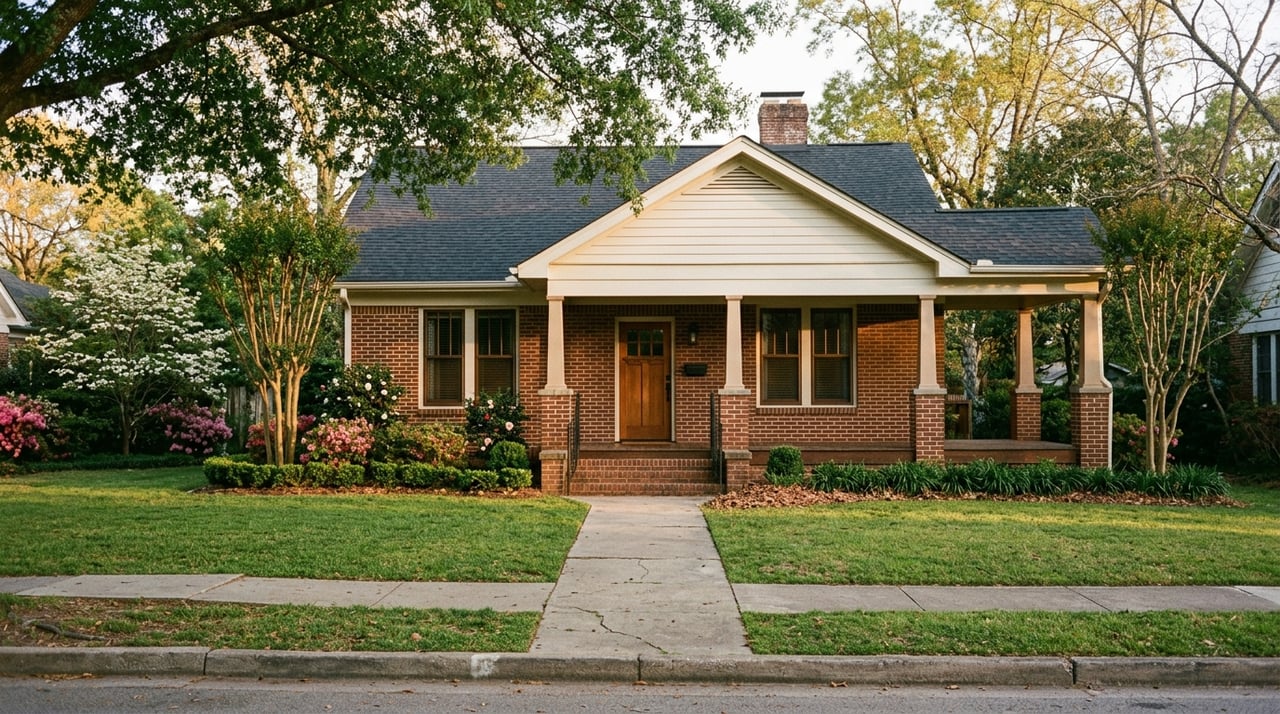
Many older Corinth homes stand out because of their exterior materials and visible details. Documented examples include wood-frame construction, weatherboard siding, stucco, brick, full or partial porches, boxed cornices, and decorative trim.
That does not mean every older home looks the same. It does mean historic homes often ask you to pay closer attention to craftsmanship, original features, and exterior condition than you might with a newer home.
Newer traditional-neighborhood development in Corinth still aims for walkability and a classic neighborhood pattern. The city’s newer TND-N district calls for mixed use, a variety of housing types, pedestrian-friendly streets, porches or stoops, and parking behind or beside homes.
So if you like the idea of a more connected neighborhood feel, you may find that appeal in both historic areas and certain newer developments. The difference is that the older districts grew more organically over time, while newer traditional areas follow a more standardized design framework.
What buyers should know about exterior changes
If you are considering a home in a designated historic district, it is important to understand that exterior changes may be more regulated. Corinth’s code says ordinary maintenance or repair that does not require a building permit is allowed as long as it does not alter exterior architectural features.
The city also says designated historic districts must meet additional historic-compatibility standards in the municipal code. Its historic preservation program is intended to safeguard and stabilize landmarks and historic districts through the Corinth Historic Preservation Commission and the Courthouse Square Historic Preservation Commission.
For you as a buyer, the practical takeaway is simple. Routine upkeep may be straightforward, but visible exterior changes may require a more careful review, especially for items such as porches, windows, siding, roofs, additions, trees, or fence lines.
Are all historic homes in one part of Corinth?
Not exactly. Corinth’s preservation sources point to two historic districts, and the city code also distinguishes the downtown core, downtown residential overlay, and historic and infill neighborhoods.
That means Corinth is better understood as having several related historic environments rather than one single old-house area. If you are searching for character, it helps to look beyond one street or one label and think in terms of the broader historic fabric.
What Corinth’s neighborhood character really comes down to
At its core, Corinth’s neighborhood character comes from a layered combination of railroad-era planning, walkable blocks, varied architecture, and local rules that work to protect the feel of older residential streets. That is what makes the city’s historic areas stand out.
If you are buying or selling in Corinth, understanding these details can help you make better decisions. You can more clearly evaluate curb appeal, lot layout, future exterior projects, and the kind of street environment that best fits your goals.
Whether you are drawn to a Greek Revival cottage, a Queen Anne home, a bungalow, or simply a block with mature trees and a traditional street grid, neighborhood character in Corinth is something you can see and feel once you know what to look for.
If you want help comparing homes, understanding neighborhood patterns, or planning your next move in Northeast Mississippi, connect with Sherrie Springer KW Tupelo.
FAQs
What gives historic neighborhoods in Corinth their character?
- Corinth’s historic neighborhoods are shaped by railroad-era development, a dense street grid, mature trees, pedestrian features, small parks, and a wide range of architectural styles documented in the city’s preservation records.
What home styles can buyers expect to see in Corinth historic areas?
- Buyers may see Greek Revival, Queen Anne, Colonial Revival, Neoclassical Revival, Craftsman, Tudor Revival, and other styles, along with traditional forms such as bungalows, four-squares, cottages, and shotguns.
What are lot sizes like in Corinth’s older neighborhoods?
- Lot patterns vary, but historic records show some narrow downtown lots and compact blocks, while the city’s historic and infill code says lots generally start at 8,000 square feet.
What should buyers know about historic-district rules in Corinth?
- Buyers should know that ordinary maintenance that does not require a permit may be allowed if exterior architectural features are not changed, but designated historic districts must also meet additional compatibility standards in the municipal code.
Are there newer Corinth neighborhoods with a traditional feel?
- Yes. Corinth’s newer traditional-neighborhood development standards still emphasize walkability, porches or stoops, varied housing types, and parking placed behind or beside homes.